130 million US households run networks they don’t control. ISPs legally sell browsing data. VPN companies promise not to look. Smart devices phone home to ad networks without permission. There is no consumer hardware solution that solves this. That’s the gap.
Since the 2017 FCC rollback, US internet providers legally sell your browsing history to advertisers. Every household is monitored and monetized — and most people have no idea.
Software VPNs replace your ISP with another company you have to trust. NordVPN, ExpressVPN — breaches, logging scandals, and opaque jurisdictions. Same problem, different middleman.
Smart TVs, phones, and IoT devices use DNS-over-HTTPS to tunnel past VPN clients. Your laptop might be covered — but your Ring doorbell, kids’ tablets, and smart TV are wide open.
$100/year for NordVPN. $100/year for ExpressVPN. Forever. Consumers pay recurring fees to rent trust from companies that can change their policies tomorrow. Privacy should be something you own.
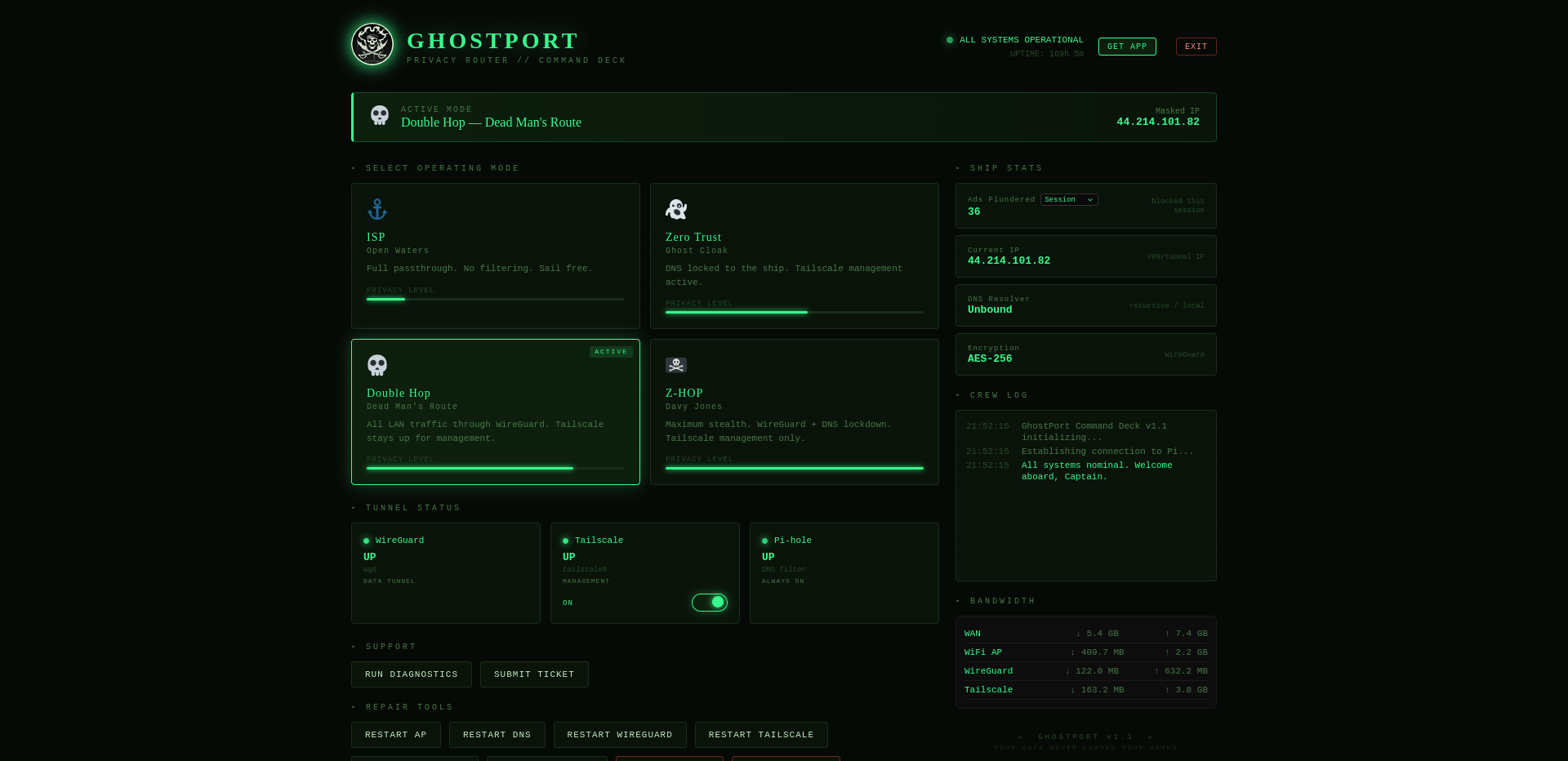
GhostPort OS turns a Raspberry Pi 5 into a privacy router. Plug it in, and every device on the network is protected — phones, smart TVs, IoT devices, gaming consoles. No per-device setup. No third party. No trust required.
Standard passthrough. Full speed. No filtering. For when you need maximum bandwidth without overhead.
Pi-hole DNS blocking + DoH/DoT bypass prevention. Phones and smart devices cannot escape the filter.
All network traffic tunneled through WireGuard VPN. ISP sees nothing but encrypted packets.
WireGuard VPN + strict DNS lockdown combined. No traffic escapes unfiltered. Full blackout mode.
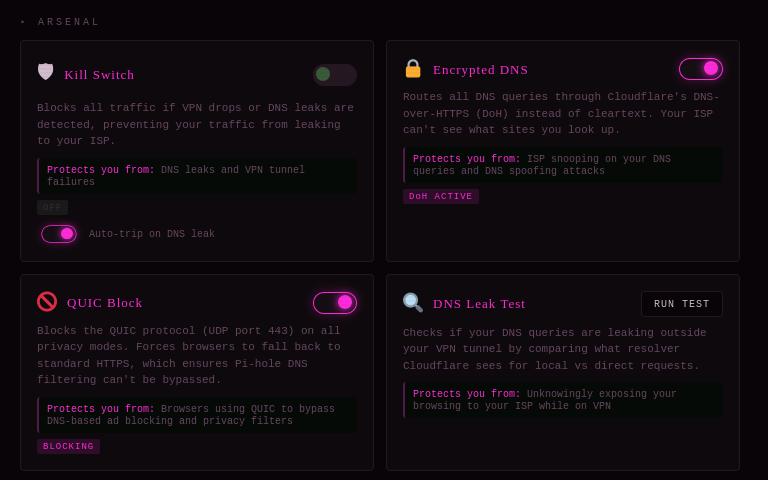
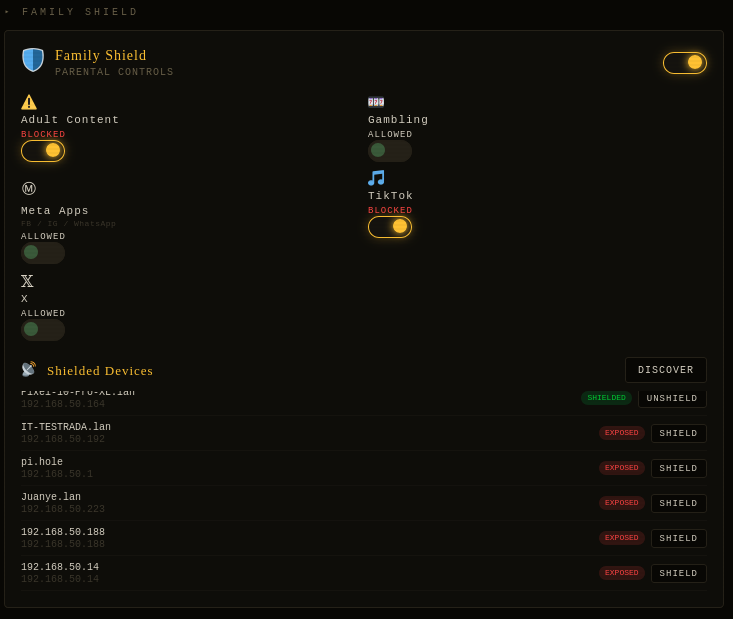
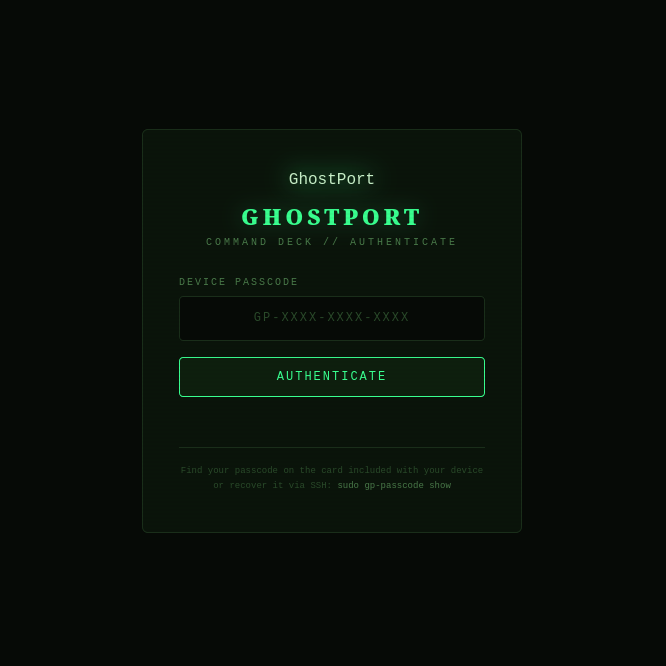
Every screenshot below is from the live GhostPort Command Deck — the actual dashboard shipping on every device. Built with vanilla HTML/CSS/JS, no framework dependencies.
TRY THE LIVE DEMO →
GhostPort isn’t a consumer UI slapped on a commodity router. It’s a purpose-built Linux networking stack with military-grade packet filtering, encrypted DNS resolution, and remote fleet management.
Four discrete firewall profiles (ISP, ZeroTrust, DoubleHop, ZHop) applied atomically via nftables. Mode switches are validated before deployment and auto-rollback in 60 seconds if unconfirmed. No iptables legacy — pure nftables.
All network traffic tunneled through a self-hosted WireGuard VPN on AWS EC2. The tunnel endpoint is dedicated per-customer — not shared infrastructure. ISP sees only encrypted WireGuard packets.
Pi-hole intercepts DNS for every connected device. DoH (DNS-over-HTTPS) and DoT (DNS-over-TLS) are force-blocked via nftables so apps like Chrome, Firefox, and smart TVs cannot bypass the filter.
Node.js Express API server on HTTPS (port 4200). Vanilla HTML/CSS/JS frontend — no React, no dependencies. Installable as a PWA on iOS and Android with real-time status polling.
Tailscale mesh VPN runs on a dedicated interface (tailscale0) that is whitelisted in every firewall profile. Remote management access survives all mode switches, reboots, and network failures.
Platform-level blocking (TikTok, Meta, YouTube, gaming networks) applied per MAC address. Schedules, bedtime rules, and bypass-proof enforcement at the router level. No app on the child’s device.
A massive, growing market with no dominant hardware solution. GhostPort enters at the intersection of subscription fatigue, regulatory tailwinds, and affordable hardware.
| Product | Price | Hardware Owned? | No Subscription? | DoH/DoT Blocking? | Family Controls? | Open Code? | Strength |
|---|---|---|---|---|---|---|---|
| NordVPN | $99/yr | ✗ | ✗ | ✗ | ✗ | ✗ | 5,500+ servers, brand recognition |
| ExpressVPN | $100/yr | ✗ | ✗ | ✗ | ✗ | ✗ | Best-in-class app UX |
| GL.iNet Router | $89 one-time | ✓ | ✓ | ✗ | ✗ | ✗ | OpenWrt, Amazon distribution |
| Firewalla Purple | $219 one-time | ✓ | ✗ | Partial | Partial | ✗ | Polished app, IDS features |
| Gryphon | $199–$399 | ✓ | ✗ | ✗ | ✓ | ✗ | Retail presence, mesh WiFi |
| ☠ GHOSTPORT OS | $275–$345 | ✓ | ✓ | ✓ | ✓ | ✓ | Full-stack transparency |
Not just hackers. Not just IT pros. Four buyer profiles, each with a specific pain point GhostPort solves that no other product addresses.
Works from home on company VPN but personal devices share the same network. Smart TV, Ring doorbell, and kids’ tablets all leak data through the same router their employer trusts.
“My company requires secure networking but my home router is from 2019 and I have no idea what it’s doing.”
GhostPort: Network-wide VPN + ad blocking. Every device protected. Zero config per device.
Kids have tablets, gaming consoles, and phones. Every app tracks them. TikTok sends data to ByteDance servers. Current parental controls are per-device and easily bypassed.
“I installed screen time limits but my kid just uses the browser. I can’t block TikTok on the network level.”
Family Shield: Block entire platforms (TikTok, Meta, gaming) per device at DNS + IP level. Can’t be bypassed.
Already uses a VPN on their phone. Runs an ad blocker. Deleted Facebook. But their smart home devices, game consoles, and IoT gadgets still phone home to dozens of trackers.
“I protect my phone but my Roku sends data to 40 different ad networks and there’s nothing I can do.”
GhostPort: Every device goes through Pi-hole + encrypted DNS + optional VPN tunnel. No per-device setup.
Needs a fast, reliable network but also doesn’t want ISP throttling or DDoS attacks hitting their IP. Traditional VPNs add latency. WireGuard is sub-5ms overhead.
“VPNs kill my ping. But my ISP throttles my streams and I got DDoS’d on stream last week.”
DoubleHop mode: WireGuard hides real IP, Pi-hole kills ad latency, nftables drops unsolicited traffic.
Three forces are converging right now to create a market window that didn’t exist five years ago — and won’t stay open forever. The first company to move wins the category.
GDPR, CCPA, state-level privacy laws, and the TikTok ban debate have made data privacy a kitchen-table conversation. Consumers are aware of the problem for the first time.
The Raspberry Pi 5 delivers 2.4GHz quad-core ARM, 8GB RAM, USB 3.0, and gigabit ethernet for $80. Five years ago, a privacy router required a $300 enterprise appliance.
Young consumers don’t believe “we take your privacy seriously.” They want verifiable, transparent, open solutions. They want receipts. We publish ours.
Priced for DIY builders, everyday families, and small businesses — each kit ships pre-flashed and ready to plug in.
| Item | Cost | Revenue | Margin |
|---|---|---|---|
| Raspberry Pi 5 (8GB) | $80 | — | — |
| Case + SD + accessories | $15–$30 | — | — |
| Packaging + shipping | $10–$15 | — | — |
| Total hardware COGS | ~$110 | — | — |
| Captain Kit sale | $110 | $290 | 62% |
| Annual VPS subscription ($8/mo avg) | ~$5/mo infra | $96/yr | 95% |
| Year 1 LTV per customer | $170 | $386 | 56% |
350 units in Year 1. Roughly 30 per month. $800/mo in ad spend. No viral moment required, no partnerships assumed. Here’s the channel strategy.
Open code doesn’t mean no moat. Defensibility comes from trust capital, vertical integration, and category ownership.
225+ bugs found and published across 11 security audit rounds. This isn’t just transparency — it’s a compounding trust asset. Every round makes the product harder to compete with on credibility. No competitor publishes their bug count.
The Elastic License v2 allows full transparency and community contribution while preventing competitors from repackaging and selling GhostPort OS. Code is viewable but not commercially redistributable without permission.
We control the full stack: hardware selection, OS image, firewall rules, VPN tunnel infrastructure, DNS resolution, web dashboard, mobile app, and fleet management API. No dependency on third-party firmware or cloud platforms.
No product on the market combines hardware ownership, DoH/DoT blocking, WireGuard VPN, per-device parental controls, network-wide ad blocking, AND an open audit trail. GhostPort is the first to check every box. Getting there first creates category ownership.
Everything below is built, deployed, and running on live hardware. Not a roadmap. A status report.
Radical Transparency
We publish our security audit log in real-time. Every bug found, every fix applied, every round documented. No other router company does this. The new generation doesn’t trust “trust us” — they want proof.
Conservative model: Captain Kit only, $800/month ad spend, zero partnerships, zero virality. Break-even by Q3 of Year 1.
No salaries. No office lease. Every dollar goes to product and growth. Each line item maps to a specific deliverable.
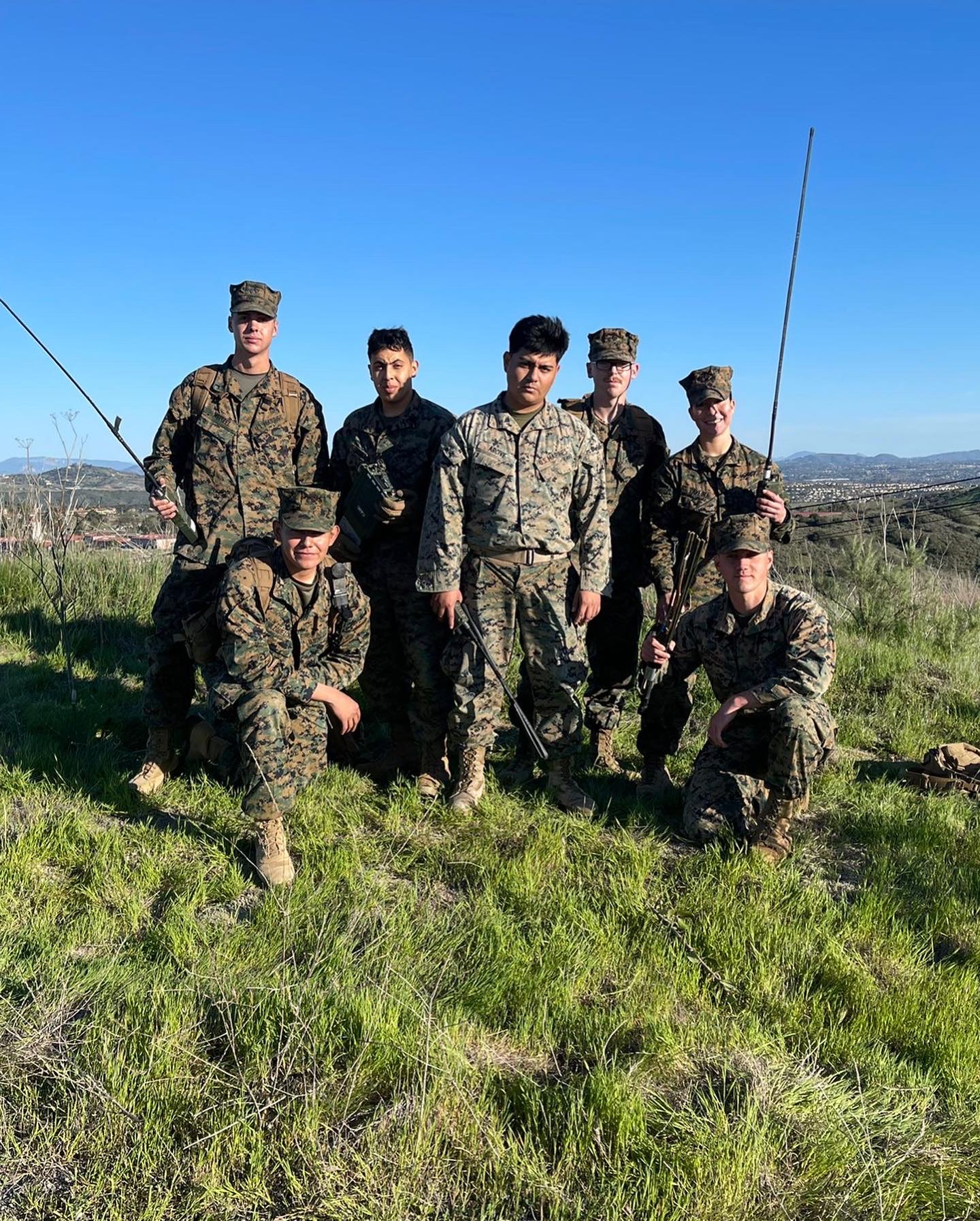
Thomas served as a United States Marine (MOS 0671 — Data Systems Administrator), trained daily on CMMC compliance and deployed on field operations to secure military communications and defend HQ networks from adversarial attack. After returning home, he worked in enterprise IT — where a real-world attack from foreign threat actors triggered the question that became GhostPort: “If billion-dollar companies can barely protect themselves, who’s protecting regular households?”

What could go wrong, and what we’ve done about each one.
Raspberry Pi availability has historically been volatile (2021–2023 chip shortage). A supply disruption could delay production runs.
Most consumers don’t know they need a privacy router. The concept requires education before conversion.
Single person building, shipping, and supporting the product. Bus factor of one.
Established players (Firewalla, GL.iNet) could add similar features. VPN companies could ship hardware.
We are raising $50K–$250K via SBA loan or small business grant. The prototype is done. This capital funds the first production run and go-to-market push.
No equity offered. No board seats. Debt or grant funding only. Revenue pays it back.